HISTORY OF ZEPHYHILLS HIGH SCHOOLPre-ZHS Education in the City of ZephyrhillsEarliest Schools in Present Pasco Countyby Celia Anderson, 1929 ZHS Graduate and ZHS LibrarianBefore 1887, when Pasco County as such did not exist but was part of Hernando County, few organized attempts to provide schooling can be documented. Although Tampa, a short distance south, was already well on the way to becoming a flourishing city, even a tourist center, settlements in what is now Pasco County were small and scattered. Adults were busy establishing homes and making a living with the result that work, rather than education, was emphasized. Parents sometimes arranged with their neighbors for two to four months school sessions, paying the teacher by the “boarding-around method” in the absence of money for salaries. In 1887 a section of Hernando County was carved out to form Pasco County. The first county school board was elected in 1888 and slow but steady progress began in the school system. G.W. Beardon was elected the first County Superintendent of Schools. A “three-mile” limit was established by the Board, stating that no school should be located within three miles of another. Another decision of the Board was that a teacher would be hired and paid when the enrollment reached twenty pupils. It was decreed that a well should be dug at each school. An interesting rule was that adults could visit schools only on business or by invitation—no one could attend just to see what was going on. A Christmas holiday of three days was established. Teacher’s monthly salaries listed at the time were: $45 for a teacher having a first grade certificate; $30 to $35 for a second-grade certificate; and $20 to $25 for a third grade certificate. An item in early school board minutes mentions E.B. O’Berry as a teacher at Slaughter earning $30 a month. Later in life Mr. O’Berry served several terms as Pasco County Superintendent of Schools. The earliest school mentioned by name in the area of Zephyrhills was Oakdale School in the community of the same name situated between Tuckerton (Richland) and the site of present-day Zephyrhills Institution, as indicated in Rosemary Trottman’s well-researched book, The History of Zephyrhills, 1821-1921. Doubtless there were early, short term schools near Abbott, the settlement destined to become Zephyrhills. Ellerslie School, near the Polk County line and New River School, west of Abbott were other early schools. In or near Dade City were schools such as Townsend House, near Spring Lake. Prospect School over the years, in more than one location, was built on the Handcart Road near the Gaskin settlement. Hebron School (near Trilby) and Macon School (former name of Trilby) were combined to form Compromise School. Matchet Lake School, on King Lake, Dr. Wirts’ former home; Blanton Sumner School; Hatton School and Chipco School (formerly Oakland School). Buddy Lake School (present Lake Pasadena, according to Rosemary Trottman, historical writer and member of a pioneer family); Indian Lake School, just north of the present Pasco-Hernando Community College (Dade City campus); River Land School near Slaughter; New River School at Earnestville near Buddy Lake; O’Berry School, near Trilby; St. Joseph’s School, Clay Sink School, Owensboro School near Trilby; Darby School were among the better known schools of the period. Professor P.W. Corr’s South Florida Normal Institute, although private, was used by the county. It was situated in Dade City on the corner of Church Avenue and Fourteenth Street near the present campus of Pasco Middle School. Myrtle Hunt (Mrs. Jerry Hunt) reports that the Chipco settlement and depot were on the property now belonging to Myrtle and her sons. Mrs. Hunt’s grandfather’s, J.E. Burnside and N.E. Eiland, both lived in Chipco at the time.
From the Land O’ Lakes Historical Trail, This area was served by a two-room schoolhouse, known as the Drexel School. In 1948, a new $50,000 school was built here, and the Drexel School became its lunchroom. It is named after Judge James Wilton Sanders, who was previously the principal of Zephyrhills High School, and from 1912 to 1920 served as the school superintendent.
Reports the following regarding the school building where Sanders
Memorial School in Land O’Lakes is now located with information
about one of the previous ZHS principals…This area was served by
a two-room schoolhouse, known as the Drexel School. In 1948, a new
$50,000 school was built here, and the Drexel School became its
lunchroom. It is named after Judge James Wilton Sanders, who was
previously the principal of Zephyrhills High School, and from 1912 to
1920 served as the school superintendent. Now Forgotten Union Country School Was Located Out by New River on West 54, Zephyrhills News, March 9, 1972 With the 23rd annual Lion’s Club sponsored Founder’s Day Festival celebrating Zephyrhills 62nd birthday anniversary, recollection of a little remembered 2-teacher school just west of New River is timely. Union School of Pasco County was located at Kenny, a community several miles west of what was then Abbott and is now practically forgotten save by real old timers.
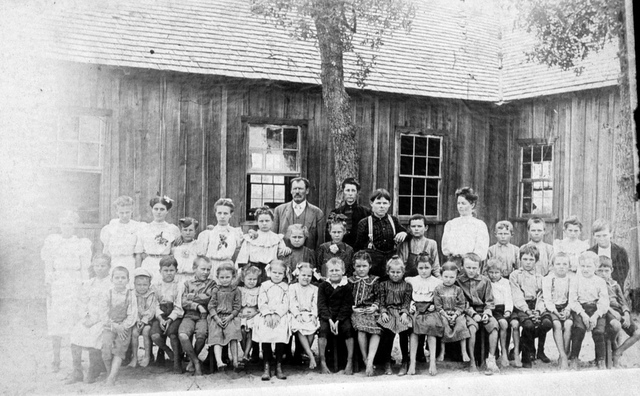
C. Milton Truex, who resides at 715 Carol Avenue in Betmar Acres, has
provided the Zephryhills News with a photograph of the student body
taken outside the 2-room frame schoolhouse in 1907, when his father,
Professor W.W. Truex, and Miss Omah Geiger had been teachers at the
school for three years.
Excerpts form “It Takes a lot of Living To fill Those 90 Years” by Daniel I. Cripe Early School days… My early school days were divided between Sand Pond, Greer, and Zephyrhills. When I think of Sand Pond, I visualize a little one room building in the Southwest corner of Fort King and Bozeman Roads. It was there for years. Originally there had been one in the woods just north and east of there in the woods. Later there was another one room school built just north of there where May Gaskin lived for many years before her son Med Junior. The Sand Pond School that I remember was the community center where all of the important things happened. We had Sunday School there every Sunday. Often times ministers of difference denominations came and preached for us. We had picnic dinners there on the ground quite often and on Christmas we had a program with a Christmas tree and all of the trimmings. People brought presents and hung them on the tree. We put on plays and had speeches by young and old. Mr. Bosfield would give his rendition of Casey at the Bat. That was a favorite. Mr. Haste had one that started off, “There was Carlo tugging away at my coat sleeve,” and I can’t remember any more, but the title was, Asleep at the Switch. My sister, Hazel McKillips, had one—“The Patience of Job” I came on stage dressed raggedy, sat down and said: “Let me sit down a minute stranger, I ain’t done a thing to you. Now don’t you start cussing, a stone got in my shoe. Yes, I’m a tramp. What if some folks say that we’re no good. But a tramp has to live I reckon, though they say we never should. It was down in Leheigh Valley that me and my people grew. It was the village of blacksmith—yes, and a good one too. Me and my daughter, Nellie—Nellie was just sixteen and she was the prettiest creature that valley had ever seen. Beaus she had a dozen. They came from near and far, but most of them were farmers and none of them suited her. Along came a stranger, young, handsome, straight and tall. Dam him, I wish I had him, strangled up against that wall. He was the man for Nellie. Nellie knows no ill. Her mother tried to tell her but you know how young girls will. Well, it’s the same old story, common enough you’ll say. He was a smooth tongue devil and he got her to run away. It was less than a month later that we heard from the poor young thing. He had gone away and left her without even a wedding ring. Back to our home we brought her. Back to her mother’s side, filled with a raging fever, she fell at our feet and died. So give me a drink, bartender, and I’ll be on my way. I’ll tramp till I find that scoundrel, if it takes till Judgment Day.”
It was in 1914 that the Cripe children
attended the institute of learning known as the Greer School. A Mr.
Martin was Headmaster that year and his daughter, Vera Martin, taught
the primary grades in the smaller room which was attached to the main
structure. Mr. Martin also had a son, Laury, who attended the school
and the three of them traveled daily from their home in the northern
part of Dade City in a top-buggy propelled by a black horse. During the
day, the horse was tied to a tree with a box nailed to it. In the box
was some grain to charge up the horse for the trip home in the evening.
Really he parked the horse behind the building but if I placed him
there in the picture, you would not be able to see him. Mr. Martin
wrote with a flourish of beautiful letters and although I tried hard, I
could never nearly match it. He was also the first person I had seen
with an artificial (or glass) eye as we called it in those days. The road running by the school was a sandy
dirt road which wove its way south-westerly through the woods, over the
hill and around a small lake to the small metropolis of Phelps Station.
The settlement included the Herndon Post Office and a turpentine still
operated by the Powell Brothers, also about a dozen houses for
employees. This is some of the remembrance of Greer
School which I will pass along to those who might happen to pass this
way. I remember one incident there—one noon the children
were playing drop the handkerchief. I was sitting too close to the
circle and one of the big girls running fast got out of the circle and
bumped my nose with her knee. The blood flew and teacher had me lie
down on my back on the step for quite a while, until it stopped. When we arrived at school, I looked the
teachers over and decided on a Miss Storms, who all of the kids seemed
to like. When classes began I was shunted to another room where there
was a teacher with no personality and her only credentials were that
she was a sister to one of the trustees. They rang two bells, one to get into line and
the other to march into your room. I remember once I was busy when the
first bell rang and was a little late getting into my room. As I ran by
the drinking fountain near the door, Professor Roberts had me cut off
and jerked his belt off and made a pass at me and the belt wrapped
around the drinking fountain with a loud bang. He was a big ugly fellow
and most of us boys were afraid of him. I don’t seem to see
any teachers anymore that the children are afraid of since a niece of
mine retired a few years back.
 The school which is describing, the original Zephyrhills School is the
one at right. This photo appeared in the Zephyrhills Colonist
on March 20, 1919, labeled, “The School House of 1909.”
This board and batten building, constructed near the end of the
nineteenth century, once housed the schoolhouse in Abbott Station which
became the city of Zephyrhills in 1910.
The school which is describing, the original Zephyrhills School is the
one at right. This photo appeared in the Zephyrhills Colonist
on March 20, 1919, labeled, “The School House of 1909.”
This board and batten building, constructed near the end of the
nineteenth century, once housed the schoolhouse in Abbott Station which
became the city of Zephyrhills in 1910.

 Pasco Superintendent of Schools, David Thrasher, is leaning back in chair at right in photo above at the Attorney’s office of Ephraim Green in the early 1900s
Pre-ZHS History from Jeff Miller of fivay project Prior to 1900—education from 1887 to 1897 in the Zephyrhills area • The Abbott School is listed in the school board minutes of August 7, 1893. A.E. Geiger is shown as the supervisor. On September 4, 1893, G.B. Pixton is shown as the teacher. On August 2, 1897, Addie Sumner is shown as the teacher. On June 6, 1898, A.G. Geiger was appointed the supervisor of the Abbott School. On August 1, 1898, J.W. Osborne was assigned to teach at Abbott. On July 1, 1901, C.F. De La Mater was appointed the teacher at Abbott. On July 6, Bessie E. Miller was named the teacher. • On August 4, 1908, the school board approved a petition from school districts #5 and #18, known as Abbott and Union, to consolidate the two districts into one to be known as Abbott #5. • On July 5, 1909, Carrie Geiger was appointed the teacher at Abbott. • A school called Oak Dale is shown in a list of Hernando Schools from the beginning -0ctober 1, 1883 (Note that Pasco County had not yet been formed). The trustees were J.M. Abbott, Elias Geiger and Jno Spivey. • Oak Dale School is shown in the Pasco County School board minutes of September 5, 1887. It was discontinued in 1888 with students transferring to Richland and Childers. |
 I have never seen a picture of the Greer
School House, except the one I drew for our Historical Association. It
is very much like the real thing. The picture at right, is a copy of
the one I drew and submitted along with the description to the
Historical Association, December 4, 1984.
I have never seen a picture of the Greer
School House, except the one I drew for our Historical Association. It
is very much like the real thing. The picture at right, is a copy of
the one I drew and submitted along with the description to the
Historical Association, December 4, 1984.