HISTORY OF EDUCATION IN PASCO COUNTYZephyrhills High SchoolPictures of Zephyrhills Schools. Zephyrhills High School Yearbooks This page was last revised on May 29, 2019. A school called Oak Dale is shown in a list of Hernando Schools for the year beginning Oct. 1, 1883, although the school did not open until the following year. The trustees were J. M. Abbott, Elias Geiger, Jno. Spivey. (Pasco County had not yet been formed.) Oak Dale School is shown in the Pasco County school board minutes of Sept. 5, 1887. It was discontinued in 1888, with students transferring to Richland and Childers.  The photo above shows the Abbott school, probably built in the 1890s. The photo appeared in the Zephyrhills Colonist on March 20, 1919, labeled "The School House of 1909." A recent photo of the Brashear-Parker home at 5050 16th Street in Zephyrhills appears in The Historic Places of Pasco County, which has: “This board-and-batten building, constructed near the end of the nineteenth century, once housed the schoolhouse in Abbott Station, which became the city of Zephyrhills in 1910. After a long tenure by the Brashear and Parker families, it was unoccupied and then owned by the Bird family, from whom Edward Cross bought the property in 1948 and used it as his winter residence until his death in 1954. Subsequently it was the winter home of his daughter Hazel Cross Van Etten.” In 1977 the property was acquired by Hazel’s youngest daughter Beulah VanEtten Hayden and her husband Joseph, who later passed it on to their son Thomas Hayden and his wife Leah, the current owners in 2007. This is the Abbott School described in the school board minutes. The Abbott School is listed in the school board minutes of Aug. 7, 1893. A. E. Geiger is shown as the supervisor. On Sept. 4, 1893, G. B. Pixton is shown as the teacher. On Aug. 2, 1897, Addie Sumner is shown as the teacher. On June 6, 1898, A. G. Geiger was appointed the supervisor of the Abbott School. On Aug. 1, 1898, J. W. Osborne was assigned to teach at Abbott. On July 3, 1899, Cooper Staley was appointed the teacher at school No. 5. (Cooper Staley became a professor of mathematics at the University of Chicago, according to a talk given by Mrs. J. A. Hendley published in the Dade City Banner on Jan. 21, 1921.) On July 1, 1901, C. F. De La Mater was appointed the teacher at Abbott. A 1901 directory of the National Education Association shows a member, Nathan McCullough, teaching at the Abbott School. He is shown with an A. B. degree from Presbyterian College in Belfast, Ireland. On July 6, 1903, Bessie E. Miller was named the teacher. On Aug. 4, 1908, the school board approved a petition from school districts #5 and #18, known as Abbott and Union, to consolidate the two districts into one to be known as Abbott #5. On July 5, 1909, Carrie Geiger was appointed the teacher at Abbott. An early settler in Zephyrhills recalled that when he arrived in February 1910 there was no room at the lodging house so he was told he could sleep in the "school house in the woods" which he described as "rather an ancient building and uninviting lodging place." He recalled it was located on what is now Ninth Street between Third and Fourth Avenues. McCormick has: "This school was built in 1910 on the east side of the railroad. The students were transported to school in two canvas covered wagons with curtains which could be drawn if raining or cold. There were benches on each side and one down the middle if necessary. One wagon drawn by two large white mules delivered the students north of town. A wagon drawn by two donkeys delivered students from the west side of town. Grace Dew’s father, Isaac Cripe, was paid 15 cents per student per day to deliver the students north of town. If he could not make the daily trip, he paid the students 15 cents each to walk." School board minutes of July 5, 1910, have: “Trustees of Abbott school came before the Board with specifications for a certain design school building. After due consideration the Board appointed J. L. Geiger, J. ?. Stansford (?) and E. G. Geiger a building committee with power to purchase material, employ carpenters and push the work to completion.” Zephyrhills From A to Z has: “In 1910, the closing of several small schools such as Independence, Childers, Union, and Sand Pond warranted the construction of the Zephyrhills Consolidated School built between Fifth and Sixth Streets and Seventh and Eighth Avenues. This two-story structure suffered overcrowding with the first enrollment of over 100 pupils, taught by four teachers. Within two years the School Board added extra classrooms to the building, along with separate buildings for primary grades. Two additional teachers accepted positions on the small faculty staff.” On Sept. 7, 1910, the Tampa Morning Tribune reported, “The School House will soon be completed. It is quite an imposing building, 30x70 feet, two stories high. It is located in the center of a block three hundred feet square, covered with a growth of oak trees. A corps of efficient teachers has been secured.” 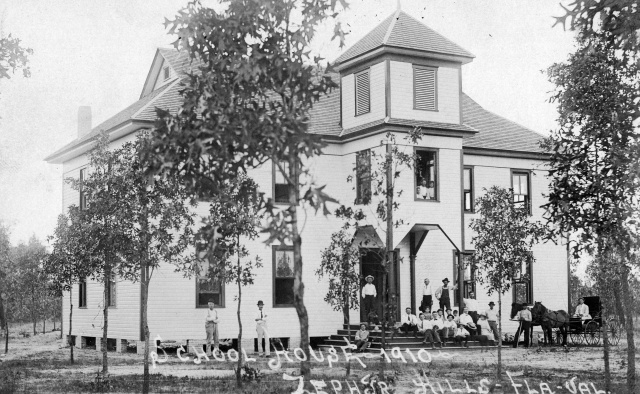 The following is taken from The History of Zephyrhills 1821-1921 by Rosemary W. Trottman: Leo Ecker and his new friends entered that first day. "About all I remember about the inauguration of the Zephyrhills High School was that the officials and a great many parents were there," Leo related. "The county superintendent, M. L. Gilbert, made a talk in which he said that the student body and the faculty represented 42 states and territories of the United States. An article about Zephyrhills in the Tampa Daily Times of Jan. 6, 1912, has: The most important thing of our beautiful little city is our school house. A little more than a year ago there was a small one-room school building located on the hill south of Fifth avenue, where school was held. Only one teacher was employed, as there were but few pupils. In the spring the teacher was turned off, as there were not enough pupils to justify carrying on the school. Today Zephyrhills has a four-room, two-story frame school house, five teachers and 150 pupils. This shows very plainly that Zephyrhills is growing, and we are proud to say that we have one of the best schools in Pasco county, with Prof. J. W. Sanches at the head. Rosters from 1911-12 show these students attending the Zephyrhills school: Austin Smith (6), Bessie Sauls (9), Bethel Geiger (8), Billie Wafford (9), Bruce Woods (6), Byron Hill (12), Charles Campbell (10), Charles Glover (8), Charley Bailey (6), Charlotte Bailey (6), Corine G..... (8), Curtis Geiger (10), Dale Leonard (10), Earle Boyette (6), Edith Wells (5), Edwin Stebbins (8), Edwina Rolf (5), Ella May Fillmon (11), Esther Ward (6), Ethel Taylor (6), Eunice Lee Craig (8), Everett Means (11), Frank Stebbins (10), Frank Studstill (11), Frankie Hedges (6), Frankie Posy (5), Frederick Russell (5), George Lambkin (12), Gerald Briggs (8), Gorden Hill (8), Guy Lambkin (14), Guy Leroy Posey (8), Harmon Geiger (10), Harry Lane (17), Helen Koontze (5), Helen Penrod (5), Henry Edmondson (11), Herbert Fletcher (10), Herman Vogt (11), Hurley Smith (6), Inis De Ryder (10), Ione Lindstrom (5), Jean Giredat (7), Jennings Gunnoe (6), Johnny Means (16), Josie Stafford (8), Katherine or Nell Hendrix (6), Kenneth Storms (8), Leola Wallace (5), Lewis Chancey (13), Lucile Gill (5), Lula Wallace (12), Lyle De Ryder (10), Mae Turner (10), Mae Wallace (10), Margaret Knapp (6), Margaret McGuire (10), Mary Briny (8), Mary Tallman (11), Mattie Fillmon (6), Moray Kersehy (14), Myrtle Briny (12), Myrtle Stafford (7), Nephi Mayo (7), Oma Williams (5), Otis Ryals (7), Paul Miller (6), Pauline Overstreet (5), Powell Ryals (11), Rachel De Ryder (8), Ralph Sauls (6), Ray Pellham (9), Raymond Cursten (8), Reida Lyda (..), Robert McGuire (9), Robley Bartholomew (6), Ruby Hensley (6), Ruth Brown (6), Ruth Storms (7), Vernie or Pearl Lisenby (6), Villa K. Brown (5). On Mar. 28, 1912, the Zephyrhills Colonist has: "We shall have no closing exercises in our schools. I thank the good patrons for their hearty cooperation during our school term. School closes Wednesday April 3d. J. W. Sanders, Prin. Z. H. S." On May 9, 1912, the Zephyrhills Colonist has: Summer School. Beginning April 15, and continuing six or eight weeks at the Zephyrhills High School Building. Tuition $1.00 per week in advance. Girls and boys desiring to attend, please make arrangements with Miss Donoho."
School board minutes from June 1913 show W. H. Stephens appointed principal at Zephyrhills. The March 1914 Official Directory of Zephyrhills and Colony has: Zephyrhills has a school worthy of praise. At the present time there are over 200 students enrolled with faculty of seven teachers prepared for full high school work. The names of the faculty are: Principal C. H. Martin, 11th & 12th grade; First Assistant Ira M. Harrell, 8th and part of 9th; Second Assistant Mrs. C. H. Martin, 10th and part of 9th; Mrs. Nina Percival, 6th & 7th grade; Miss Cara R. Falana, 4th & 5th grade; Miss Lilly Geiger, 1st & 3rd; Miss Mae Burkett, Primary & 2nd grade. Two years ago, a good school building with four rooms was erected and when two terms were taught in this building, it was found that more room was necessary, so two rooms were added a few months ago. C. H. Martin, referred to above, was Clarence H. Martin. He and his wife, Antoinette Martin, were both school teachers. He died in 1921; his wife taught school in Bartow, where she died in an auto accident. They are both buried in the Dade City Cemetery. This information was provided by Laveda Martin Rogers, their granddaughter. On Aug. 9, 1914, the Tampa Morning Tribune reported, “The Zephyrhills High School will be opened for the fall term, which is to begin the fifth term on September 7, with the following faculty: Messrs. Pheney and Matthews, Misses Sumner, Schenck, Percival, Carter, Geiger and Storms.” An article about Zephyrhills in the Dade City Banner of Dec. 4, 1914, has: School opened Monday morning with eight teachers and 185 pupils. All the children were not out the first day; will probably run to two hundred and fifty, as many of our settlers have not yet returned from their visit to the north. This school opened with eleven pupils the fall of 1909, did not keep the average up to 10, so the school was disbanded. The fall of 1910 school opened with 61; this was the first year of the colony. The fall of 1911 opened with 79. The fall of 1912 opened with 103. The fall of 1913 opened with 171. The fall of 1914 opened with 185. This is a very good showing for a town only four years old. There were 206 pupils enrolled last year and this year will go away beyond that number as quite a number of families have been added to our colony since last spring. On May 3, 1915, these teachers were appointed for Zephyrhills: Prof. William Cleveland Finney (Principal), Ruth Sumner, Miss Birdena Schenck, Prof. Vassar C. Mathews, Lillian Carter, Lillie Geiger, Miss Wanda Briggs, Miss Nina Percival, Muriel Storms. (A 1914 newspaper article has the name Miss Bonnie B. Schenck.) A 1915-16 directory shows 209 students attending the Zephyrhills school, with 33 pupils above the eighth grade. The teachers were W. C. Finney, Miss Ruth Sumner, Miss Berdina Schenk, V. C. Mathews, Miss Frances Laughinhouse, Miss Lillie Geiger, Miss Uarda Briggs, Miss Marie Stewart, and Miss Muriel Storms. It Took A Lot of Living To Fill Those 90 Years by David I. Cripe has: After a year at Greer, we were transported to Zephyrhills by Mr. Rabe Overstreet in a canvas covered wagon, drawn by two white mules. That was our transportation for about half of the term. When the county money ran out, we walked. It was only three miles. On April 27, 1916, five students graduated: Julian N. Ticknor, Nannie M. Knight, Newell N. Wright, S. Blanche Geiger, and W. Gomer Krise. At the school board meeting of July 3-5, 1916, appointments to the Zephyrhills school were: Principal, M. J. Okerlund; high school, Miss Berdina Schenck and Mrs. Jessie N. Priest; eighth grade, Prof. V. C. Mathews; other teachers, Miss Flora Ingalls, Miss Lillie Geiger, Miss Uarda Briggs, Miss Marie Stewart, and Miss Muriel Storms. On May 25, 1919, the Tampa Morning Tribune reported, “The graduation exercises of the Zephyrhills high school were held in the G. A. R. hall Wednesday night. There were four graduates to receive diplomas from the hand of Principal Walter Roberts. ... Kenneth Storms gave the class prophecy, being valedictorian for the class.” On Nov. 21, 1919, the Dade City Banner reported, “Prof. Walker of Dade City has taken Prof. Roberts position as principal of the Zephyrhills high school.” The school board minutes of Dec. 1-3-4, 1919, have: “Matter of complaint in regard to principal of the Zephyrhills school was discussed and Board decided to investigate complaints and visited the school on Dec. 3rd. and decided to continue services of Principal Walker.” On April 2, 1920, the Banner reported, “... the high school has been seriously handicapped this year by changes and lack of principals.” On Apr. 21, 1921, the Zephyrhills Colonist reported the graduates of Zephyrhills High School were Lue Genia Culbreath, Grace Cripe, Nellie Ford, Edwin Stebbins, Warren Haynes, and Roy Stewart. On Jan. 7, 1922, Zephyrhills High School lost a basketball game to St. Petersburg 66-8. The graduates in 1922 were Allene Bates (nee Culbreath), Helen Parker, Helen Reutiman, Jennie Harris, Pearl Price, Fred Stebbins, and Floyd Overstreet. (Mrs. Bates, the valedictorian, and her husband, James Warren Bates, were both teachers in Hillsborough County in the 1930s.) The 1924 report of the superintendent listed three Pasco County schools "doing Senior High work," Pasco, Zephyrhills, and Gulf, although only Pasco was accredited that year as a Senior A school. On Sept. 12, 1924, the Dade City Banner reported: The Zephyrhills Public Schools got off to a flying start Monday with the Rev. J. B. Blanchett, D. D., as principal and a full corps of capable assistants. Dr. Blanchett was assistant principal last year and is a teacher of exceptional ability. The other members of the faculty are L. R. Bailey, B. S., C. E., assistant principal, Mrs. Guy, Mrs. Pennington, Misses Cripe, Ford and Stewart. Mrs. Alice Rogers and Miss Dorothy Briggs are acting as supply teachers. The enrollment of the school is 210. On June 20, 1925, voters of School District No. 5 voted by a majority of better than 3 to 1 in favor of a bond issue of $50,000 for the construction of a new high school building in Zephyrhills. According to Zephyrhills From A to Z, the Zephyrhills Consolidated School burned in 1926, but the primary school buildings escaped the blaze. This was the two-story building between 7th and 8th Streets. On Apr. 23, 1926, the Zephyrhills News reported: "The Commencement of the Zephyrhills Accredited Senior High School will be held Friday evening, April 26, at the G. A. R. Hall, this city, at Eight o'clock, to which the public is cordially invited. The Class is composed of Six Graduates, namely: George Neukom, Helen May Linkey, Ester N. Plank, Bessie Kate Pennington, Iris Hartt, and Cyril Cockrell. ... Dr. H. S. Filmer of Brown University will deliver the oration." On Jan. 29, 1926, an article in the Zephyrhills News reported that a $50,000 high school building was under construction. The new school opened on Aug. 30, 1926. [The building was scheduled to be demolished in December 2006.] On Oct. 8, 1926, the Zephyrhills News reported that the new $50,000 city school was overcrowded and had no playground equipment, and that an election calling for sufficient funds to improve the school was called for Saturday, Oct. 16. However, on Oct. 16 the voters rejected the issuance of $20,000 worth of bonds for additional school rooms, furnishings, and playground equipment by a vote of 108 to 62. On Sept. 1, 1933, the Dade City Banner reported: The high school building at Zephyrhills suffered materially from a fire that was discovered early Tuesday morning, and it is stated that only through prompt and efficient work by the local fire department that total destruction of the building was averted. The fire originated in the laboratory and all indications point to incendiary origin. The blaze was discovered in the west wing of the building at about 2:30 o'clock, by night watchman Frank Forbes. Within about three minutes, it is stated, Fire Chief Kerr and his associate fire men were on the grounds, working faithfully to save the building. Although a large area of the roof was destroyed and considerable fire and water dam age sustained throughout the west wing, it is stated that the walls remain intact with the exception of the laboratory room and adjoining rooms, which will have to be rebuilt. Considerable laboratory equipment was destroyed by the flames. On Dec. 20, 1935, the Dade City Banner reported: Progress is reported by James Ward in charge of the WPA project under which the fire-damaged Zephyrhills school is being rebuilt and enlarged. New material is arriving and a considerable amount of tile and brick has been salvaged from the second story which has been torn down. The completed one-story structure, as it has been planned by Couch and Parslow, Tampa architects, will cover almost a city block and will extend 234 feet from the east to west entrances. In the center the old building will be used with an addition at each end, a ... wing on the east end and a wing on the west end. The building will be of brick, with metal roof, and will include 12 class rooms and a large auditorium. The ceiling of the present auditorium will be raised. Forty-five men will be employed on the construction work, working 16 days a month. It is planned to have the building ready for the next term of school. On Feb. 21, 1936, the New Port Richey Press reported on a basketball game between the Zephyrhills Breezers and the Gulf High Cooties. On June 21, 1936, the Tampa Tribune reported, “Prof. L. E. Rowland, who for the past three years has been principal of the Zephyrhills schools, is retiring to his country home, northeast of here.” On Sept. 4, 1936, the Dade City Banner reported that J. T. Campbell Jr. was appointed Principal of Zephyrhills High School, and these other teachers were also appointed: J. D. Nelson, Clark Woodward, Miss Aurilla Driggers, Miss Clairnell O’steen, Miss Edith Plank, Miss Sara Krentzman, Mrs. Bertha McKillips. The newspaper also listed teachers appointed to Zephyrhills Grammar School. On Sept. 11, 1936, the Dade City Banner reported: An impressive Labor Day event was the dedication of the new Zephyrhills school building, the highlight of an all day celebration in that city. The attractive modern building, erected through a WPA project sponsored by the county school board, replaces the former building which was destroyed by fire a few years ago. A feature of the morning was the raising of the flag presented to the school by the Spanish American War Veterans post, with the ladies of the G. A. R. taking part in the ceremony. At noon the many visitors were served with a picnic lunch donated by the merchants of Zephyrhills. The first speaker of the afternoon was Congressman J. Hardin Peterson, who in outlining the many WPA projects of his district pointed out that the erection of the Zephyrhills school was one of the most worthwhile. He was followed by Judge O. L. Dayton, sr., who spoke impressively on the value of education. Mrs. Margera L. Otto, chairman of the county school board, stated in her address that she considered the erection of the Zephyrhills school one of the most worthwhile projects accomplished during her term of office. Senator Fred L. Touchton made an impressive talk, emphasizing the many accomplishments of the WPA and other federal agencies, and ending with a glowing tribute to President Roosevelt. The program was concluded with addresses by the different members of the local board of trustees, and appropriate selections by the Zephyrhills band were interspersed throughout the program. Many out of town guests joined the large number of Zephyrhills citizens who attended the celebration. (The new school building later became the core section of Zephyrhills Middle School.) On June 17, 1940, these teachers were appointed to the Zephyrhills school: Carol Ramage, English; Donald Turner, Science, Coach; Clement Combs, Commercial. On Sept. 4, 1940, these teachers were appointed: Margie Reutiman; Charlotte Fast, Commercial; Carolyn Sistrunk, Music; W. W. Jackson, Math, Science. 
On Oct. 3, 1941, the Dade City Banner reported, “A rejuvenated St. Leo team, full of punch, power and tricky plays, downed the Zephyrhills football team Thursday, September 25, by a 47 to 6 score. It was the first game of the season for both teams, and the first official game to played by any Zephyrhills High team.” The following article about the first football team is posted at the Zephyrhills Depot Museum: In 1941-42 the first football team at ZH was organized under the direction of Principal Birch Cornelius and Assistant Coach W. W. Jackson. The team played a 10-game schedule and had a perfect record—“NO WINS.” According to bigcountypreps.com, the football head coaches are as follows: 1941, T. Burch Cornelius; 1942, 43, no team; 1944, 45, 46, Gerald Hatch; 1947, Louis Cappola; 1948 through 1961, Johnny Clements; 1962, Bill Worthington; 1963, 64, Will McRaney; 1965, William Neal; 1966, 67, Johnny Clements; 1968, 69, 70, 71, 72, 73, Bob Alwood; 1974, 75, 76, Alan Knight; 1977, 78, Dan Sikes; 1979, John Blackburn; 1980, 81, Paul Greer; 1982, 83, 84, Jim Davis; 1985, 86, 87, 88, Barry Gardner; 1989 through 2008, Tom Fisher; 2009, Troy Hochstetler/Greg Mathis; 2010 through 2015, Reggie Roberts. The Dade City Banner reported on Oct. 4, 1946, that the team was stronger and “determined to get its first win.” In September 1947 Zephyrhills defeated Largo in football, 12-0. This was the first conference win ever for the Bulldogs. In 1950, 28 students graduated from Zephyrhills High School. In June 1951, the school board accepted the resignation of Principal Leon R. Luckenbach, who quit because he refused to grant a diploma to a member of the senior class who had joined the Marine Corps. Luckenbach refused to attend the graduation exercises. A member of the board of trustees and a member of the school board asked Luckenbach to grant the diploma, but Luckenbach refused, reportedly because the student lacked a quarter of a credit. According to school board members, state law allowed a member of the armed forces to receive a high school diploma who lacked as many as 2½ credits. On Apr. 17, 1952, these teachers were appointed to the Zephyrhills school: Mrs. Celia Anderson, John Clements, Mrs. Constance Kaylor, Mrs. Mack H. Matthews, David Clark, Mrs. Frances Kelly, Mrs. Helen Hamilton, Mrs. Pauline Higginson, Mrs. Vianna Gall, Mrs. Isabel Barnes, Miss Jane Maxwell, Mrs. Hettie Jane Price, John T. V. Clark, Mrs. Alpha Gill, Terry Kirton, Mrs. Marjorie Parantha, Mrs. Rosemary Trottman, Miss Jane Lee Evans, Miss Lots Johnson, Mrs. Esther Austin, Mrs. Mabel Campbell, Mrs. Willie Mae Ellmaker, Mrs. Modesta Hart, Mrs. Eva Zarth. On Apr. 28, 1960, these teachers were appointed to Zephyrhills High School: Mrs. Betty Hall, E. L. Kretschmar, John H. Geiger, James Eikeland, Miss Caroline Jones, Lamar Calhoun, Mrs. Katherine W. Swing, Mrs. Marjorie Parantha, Lewis Wynne, Earl F. Reitz, Miss Ann Grayson, Mrs. Alpha S. Gill, Jack L. Wilson, Mrs. Constance C. Kaylor, W. A. Worthington, John Clements, John T. V. Clark, Stanly B. Kendrick. On Jan. 15, 1961, the Zephyrhills basketball team defeated Pinecrest 138-18 on the Bulldogs’ outdoor court. On March 10, 1962, Zephyrhills won its first Class B state basketball championship by defeating Blountstown 60-58 at Gainesville. The coach was Jack Wilson, who had been at ZHS for four years. After winning the state championship, he returned to Indiana. (Zephyrhills another state title in 1964 under coach Charles McKinney by defeating Mount Dora, 33-29.) In March 1964 Zephyrhills won the Class B state basketball tournament. It was the second time in three years that the team won the state championship. Groundbreaking for the new Zephyrhills High School took place on Dec. 19, 1973. Participating in the groundbreaking were Otto Sondergaard, project superintendent of Gulf Contracting Co., Inc.; Mrs. Bonnie Zimmer, School Board member, School Supt. Raymond B. Stewart; James Davis, principal, Zephyrhills High School; Leon Milton, School Board chairman; and Bob Deason, Gulf Contracting project manager. On March 9, 1975, the St. Petersburg Times reported that the new Zephyrhills High School was nearing completion. It was one of eight new schools that were built with the proceeds of a $16-million bond issue approved by Pasco voters in September 1972. This school is located at 12th Street and Highway 54.The new high school building was dedicated on June 15, 1975. The dedication speaker was Rep. Richard Kelly. In 1984 the girls cross-country team, coached by Dave Jones, won the first girls regional championship, and became the first girls team in Zephyrhills history to win a state trophy, finishing second. In 1986 the girls basketball team, coached by Ernie Pittman, reached the 3A state tournament at Winter Park, where its four-overtime win over Hallandale in the semifinal was one of the most memorable games in tournament history. The Bulldogs subsequently lost to Gibbs High School in the title game, 51-37. On July 13, 1987, the St. Petersburg Times reported that Apple donated 15 Macintosh Plus computers with printers to Zephyrhills High School as part of an experiment. The newspaper reported that the school had in place a $100,000 computer system that Apple executives said was the most extensive computer network system of its kind in a K-12 classroom setting. In 1995-96 the football team had a 10-0 record, its first perfect record since the school began playing football 41 years ago, according to the St. Petersburg Times. In December 2005 Assistant Principal Ron Cherry retired after 35 years at Zephyrhills High School. He had started as a math teacher. Construction of a new classroom wing, a two-story building with eight classrooms on the north side of the campus, began in December 2008. In December 2008 Tom Fisher retired as head football coach, having held the position for 20 years. He led the program to a 124-89 record. In May 2009 Steve Van Gorden was named principal. In August 2009 newly-hired football coach Jerrell Cogmon was fired, in part because of possible recruiting violations. Cogmon was the first black head football coach at ZHS. Reggie Roberts became head football coach in 2010. He was a 1990 ZHS alum, and a former Bethune-Cookman linebacker. He went 39-23 in six seasons. In October 2012 principal Steve Van Gorden was placed on paid leave while the school district conducted an investigation. He subsequently resigned and was replaced by Andrew Frelick. On June 17, 2015, Angie Stone became principal. On Oct. 8, 2016, the Zephyrhills football team defeated Ridgewood 71-12. On Nov. 4, 2016, the Bulldgos defeated the Pasco Pirates 46-0 and finished the regular season with an 8-2 record. On Sept. 22, 2017, the Bulldogs defeated Fivay in a football game 70-0. On Oct. 27, 2017, the field at Bulldog Stadium was named and dedicated in honor of former coach Tom Fisher. Zephyrhills defeated Hudson 63-0 in the football game played that night. The 2018-19 football team had a 10-0 regular season record, and won one of two games in the playoff system.
Flora Anita IngallsThe following is taken from The History of Zephyrhills 1821-1921: Miss Flora Anita Ingalls, niece of Mrs. Curtis, came to Zephyrhills to teach English in the Zephyrhills High School. Her home like that of the Curtis and Forbes families had formerly been in Illyria, Ohio. She ranked with Miss Lillie Geiger in her ability and skill in teaching. She taught English at the same time that Jessie Nutting Priest taught Latin. Mrs. Priest came to the school from the Crystal Springs Colony. Her father, the same Reverend Nutting who for so many years had been the pastor of The Little Brown Church of Nashua, Iowa, had retired to Crystal Springs and there built a replica of the little brown church and a small house beside it, also painted brown. His daughter rented a small house just east of the Hohenthaner home on North Eighth Street where she lived on school days returning by train on Friday to her little brown house close to the railroad in Crystal Springs. There she rested, looked after the welfare of her parents and returned to Zephyrhills by train for another week of teaching.Isaac CripeThe following is taken from McCormick’s history of Pasco education.Mr. Isaac Cripe was not only one of the early "bus" wagon drivers, he had a contract with the county to build one-room, board-batten schools. He built a school at Pasco west of San Antonio, Fivay junction west of U.S. Hwy. 41. He also built a school in New Port Richey. Doc Cripe taught there. He built a school in Hudson. Grace said that her father would set up a tent and build the school under the tent. Mosquitoes were a major problem during the construction of the building. Zephyrhills School grades 1-12 was located at 38505 10th Avenue for many years. West Elementary, Woodland Elementary, Chester Taylor Elementary, Raymond B. Stewart Middle School and Zephyrhills High School grew out of the original Zephyrhills School.
Remembering the Zephyrhills SchoolGeorge L. Smith, grandson of Joseph Ernest Leckley, contributed the following recollections of the Zephyrhills school, taken from The History of Zephyrhills 1821-1921 by Rosemary W. Trottman. There is much that can be written about the school. Some of my recollections may add a little that will be useful. First, and most important, two of the finest teachers I had in twelve years were my first grade teacher, Miss Lillie Geiger, who taught the first grade for many years and who I understand was a highly capable teacher and Miss [Grace] Cripe, who started teaching when I started in the fourth grade and then taught our class as it progressed through the fifth and sixth grades. It is my belief that these two teachers would have been a credit to any school system in the country. I was in the seventh grade when we moved to Ohio to live and after being in the city school for several weeks my 'home room' teacher asked me to stay for a few minutes after school one day. She asked me to tell her about the school I had been attending. She knew that I had come from a small school in Florida and told me that she had understood that such schools were behind the schools in Ohio, but since I had progressed as far in the first six grades as the local children she believed that the information she had received earlier was in error. Of course, the answer is that I was undoubtedly behind in 'gym,' music, art, and wood work, but had just as much readin', writin', and 'rithmetic. I recall that one day Miss Cripe asked the boys in the class to stay after school and she told us that if each one of us would bring 15¢ or 20¢ to school she would order a soccer ball for us to play with at recess and before classes started in the morning and afternoon. Finally the big day arrived (and the ball did also). There arose the question as to who would care for it when it was not in use. A vote was taken to decide the fortunate (?) one. I was the winner. Since I was the smallest boy in the class, many of the other boys believed I would be a pushover and the ball would be available for use at times other than those anticipated. I knew what would probably happen and agreed to take care of the ball only if I could name a helper. It was agreed that I could do so. I named my pal, Kenneth Garique, the biggest boy in the class. We had no trouble controlling the ball. One year my grandfather was janitor of the school and I helped sweep the school rooms each evening after school. The school had a unique water fountain; at least I have never seen another like it. It was a metal lined trough with a pipe running the length of it. The pipes had holes spaced 18"-24" apart. There was a tank up on a stand perhaps ten feet high with a gasoline engine that pumped the water into the tank. Before school and at recess my grandfather would turn the water on and water would shoot up out of the holes in the pipe and after he had got the pressure controlled so that the water would come up 6"-12" the children would take turns getting a drink. As I recollect I was quite proud that my grandfather figured so prominently in the operation of the school. Once (perhaps many times) the tone of the school bell had a very unusual ring. This was due to the fact that the principal rang the bell with a hammer because the clapper of the bell had been removed the night before which was Halloween. |